Our work
Education as reparation
Conflict is widely recognised as one of the biggest factors disrupting children’s access to education globally. The consequences are immense: according to rights groups, 17.4 million children are out of school in Sudan[1], an estimated 2.8 million in South Sudan[2], and approximately 235,000 Rohingya refugee children aged 5–17 remain out of school in Bangladesh[3].
Survivors of conflict-related sexual violence often identify education as a top priority for themselves, their children, and grandchildren. Even when a conflict has ended, children affected by sexual violence routinely drop out of school due to unresolved trauma, physical injuries, financial insecurity, and discrimination and bullying from their peers. Meanwhile, children born of sexual violence are routinely barred from enrolling in school due to a lack of civic documents. For those who can attend school, they often face deep prejudice and ostracisation. All of this puts children at risk of further violations, including sexual exploitation and/or recruitment from armed groups.
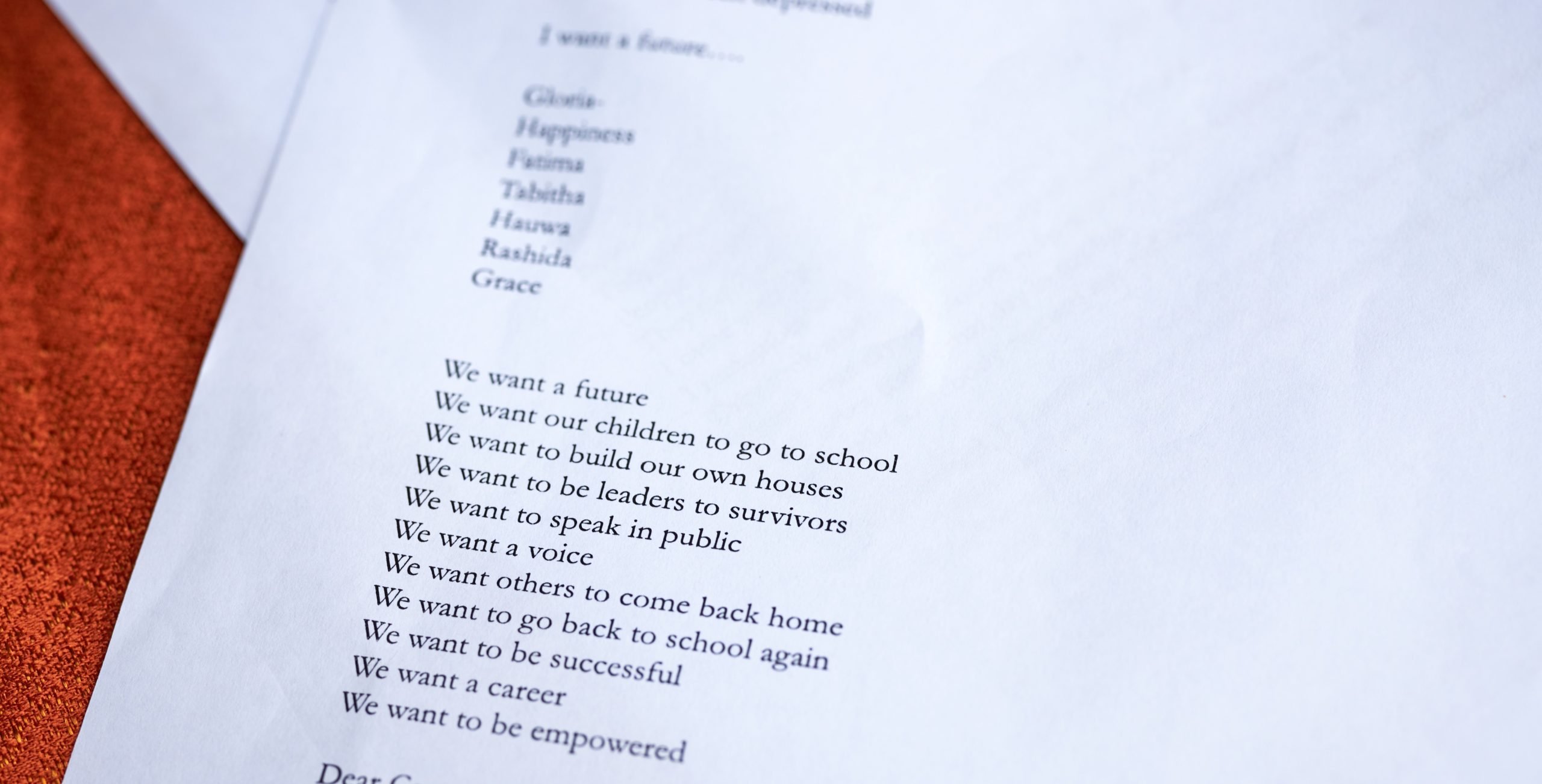
What I went through as a child left deep wounds in my heart. I didn’t feel like I belonged anywhere. But this learning centre gave me the chance to heal. I no longer feel broken. I feel like I matter.
— A survivor in Nigeria
What does education as a form of reparation look like?
While education is already a recognised right that States must fulfil, education as a form of reparation goes beyond this, acknowledging the harms caused by sexual violence and working to repair the many wounds inflicted by such atrocities. These include trauma, chronic stress, and untreated physical and mental health conditions that can affect concentration, memory, attendance, and behaviour in the classroom. Financial support can also help families who cannot pay for books or school meals or uniforms.
Delivered in this manner, learning transforms into a tool for healing, justice, recognition, social reintegration, and reconciliation, allowing children who are often left behind to begin to recover and rebuild their futures.
Education can fulfil various forms of reparation:
- Rehabilitation (by rebuilding emotional stability and confidence);
- Restitution (by restoring access to schooling);
- Compensation (by offsetting the long-term economic damage faced by survivors and their families);
- Non-repetition (by reducing exposure to further violence, exploitation, and recruitment by armed groups).
Our work in Nigeria
In Nigeria, our partnership with the Neem Foundation has shown that education as reparation is possible. Through their flagship programme in Borno state, girls affected by the Boko Haram insurgency are welcomed back into the classroom using trauma-responsive methods at the Lafiya Sarari school. Students follow a curriculum based on values such as peace and tolerance, which Boko Haram and other armed groups sought to destroy. Other boys and girls follow an accelerated, tailored learning programme before integrating private schools across the state.
We know that Neem’s expertise in working with children affected by conflict, in particular sexual violence, can be replicated elsewhere, such as in South Sudan. In the coming years, GSF and Neem will work together on a multi-country initiative with survivors, local organisations, and education actors, among others to help make education as reparation a reality for thousands of children.
We call upon all actors, in particular States and donors, to: explicitly recognise children affected by conflict-related sexual violence as victims eligible for reparation, integrate education as an explicit form of reparation in national reparation frameworks and post-conflict recovery plans; invest in the capacity of teachers and schools to adopt healing-centred and trauma-responsive approaches, and support the adoption of the GSF-Neem model in other conflict-affected contexts where children are excluded from education.
[1] https://www.savethechildren.net/news/2024-review-one-three-children-conflict-and-fragile-countries-out-school-new-analysis
[2] https://www.unicef.org/southsudan/what-we-do/education
[3] https://www.savethechildren.net/news/2024-review-one-three-children-conflict-and-fragile-countries-out-school-new-analysis ; https://www.unicef.org/southsudan/what-we-do/education ; https://www.unicef.org/emergencies/rohingya-crisis