
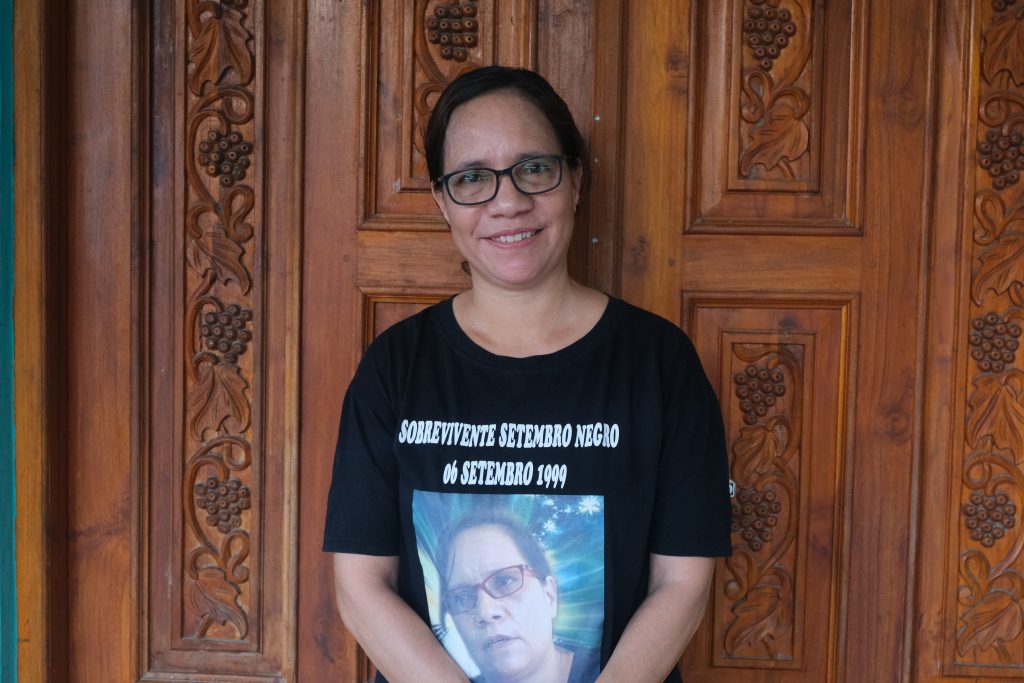
It is hard to imagine a quiet moment for Maria Amaral, from the southern Timorese town of Suai. As we meet her outside her family’s guesthouse, she has just returned from our project debrief in the capital Dili, a six-hour drive north, where she spoke as a member of the Steering Committee, a vice-president of the Pirilampu survivor network, and a dinamisadora.
On this hot afternoon, she is dressed in a black T-shirt commemorating the 1999 ‘Black September’ massacre at the nearby church, where she now serves as a memorial coordinator. Many survivors we meet around the town joined the project through her.
“I don’t relax during the day,” she says, laughing.
On the Steering Committee, Maria represented survivors like herself, but her knowledge didn’t only come from her own experience.
As a dinamisadora, or survivor mobiliser, she walked alongside survivors through every stage of the project, explaining to them their rights, encouraging those she knew to come forward, and helping them to make choices for their bukae*. With many survivors now elderly and living in rural areas, dinamisadoras are a vital lifeline and are there for their daily struggles, from health issues and buying food, to loneliness and just needing someone to talk to.
The network predates the interim reparative measures project and was set up by our partner Asosiasaun Chega Ba Ita (ACbit), which works specifically with women survivors. Many, but not all, are survivors themselves or are their children and sisters.
Maria covers Covalima’s villages of Fohorem and Zumalai. Fohorem is an eight-hour drive from Suai through Timor’s mountainous – and often unpaved – roads. The long journeys she undertakes are far from an exception.
“I joined to be the eyes, ears and hands of women out in the community,” Marquita dos Santos, from Baucau, told GSF.
She began working with survivors in 2019 after joining a training with HAK, a Timorese human rights organisation, and then as a translator for ACbit, working in Tetun and Baucau’s Makasai dialect. She is now responsible for supporting 47 people in the Quelicai region.
“The survivors had a lot of trust and faith in me. They had to be patient.”
“Even it was raining or hot, no matter what, I would still go and see them. In a lot of places, the road didn’t even reach their homes so I would have to walk. I just had to find a way to get there.”
Her schedule varies, sometimes seeing several survivors in one week. Others she sees monthly. Some are people she knew previously, whereas others were new relationships to build. She describes treks up side roads to deliver basic goods to survivors’ homes, and says her work can bring up mixed emotions.
“There is a mixture of happiness and sadness. Sometimes they’re alone so we become their friends, the ones they are closest to. We become like their daughters.”
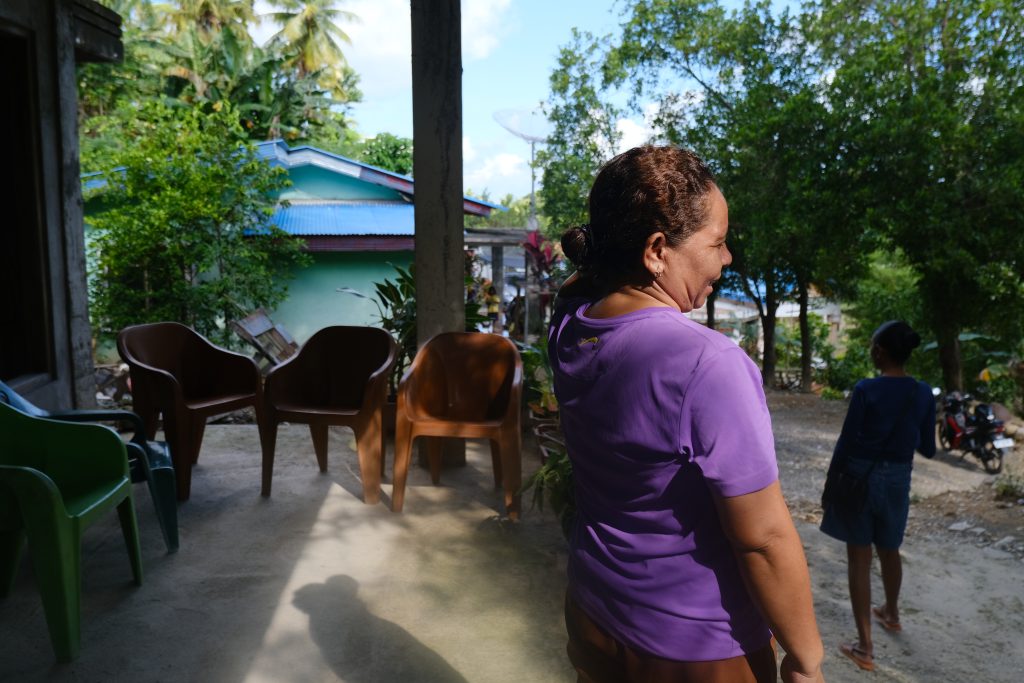
Back in Suai is Fatima, a dinamisadora and survivor who welcomes us outside the two-storey home she has finished with her bukae compensation. As we sit on her newly built terrace, where she is excited to welcome her children now studying in Dili, she recounts stories of hazardous journeys to reach survivors.
“Sometimes it would take eight hours to reach a village, we would visit the survivor, and then come back the same day.”
“If we want to continue the fight for justice, then it’s something we just take in our stride. At the end of the day, if I get to meet them and see if they’re okay and check-in, that’s the most important.”
For Maria, the project gave the women volunteers “the space to learn how to become a leader, how to work in the community. It’s not easy.”
In Dili, dinamisadoras and their coordinators (both men and women) came together to reflect on the project over the course of two days. In almost every conversation, they spoke about the importance of reaching others who were not part of the project, as well as remembering those who have passed away. Prayers for deceased survivors were held at each event, often broken by the sound of quiet tears. It is clear that they care deeply for all survivors, not just those who are involved here.
All of them cited long, arduous journeys to reach survivors as a challenge, alongside complicated relations with family members and, in some cases, opposition from community leaders. It was clear, however, that they are proud of what they do, and are committed to the people they support.
“I can’t read or write, but I am a dinamisadora. I can walk in the street without feeling ashamed,” one woman shared.
At the end of the Dili session, they gather in a circle to share their final thoughts after three years of hard work. After a group prayer, many shouted words of inspiration and hope, telling each other that they are strong, and that together their fight will continue:
“Together, small streams become big rivers; strong women, strong nation; Bukae may end but our fighting spirit continues; small lights get brighter and brighter.”
*Bukae is a traditional Timorese basket used to carry provisions for a long journey. The name was chosen to symbolise the role of interim reparative measures in survivors’ long quest for justice.