
Articles
FEATURED
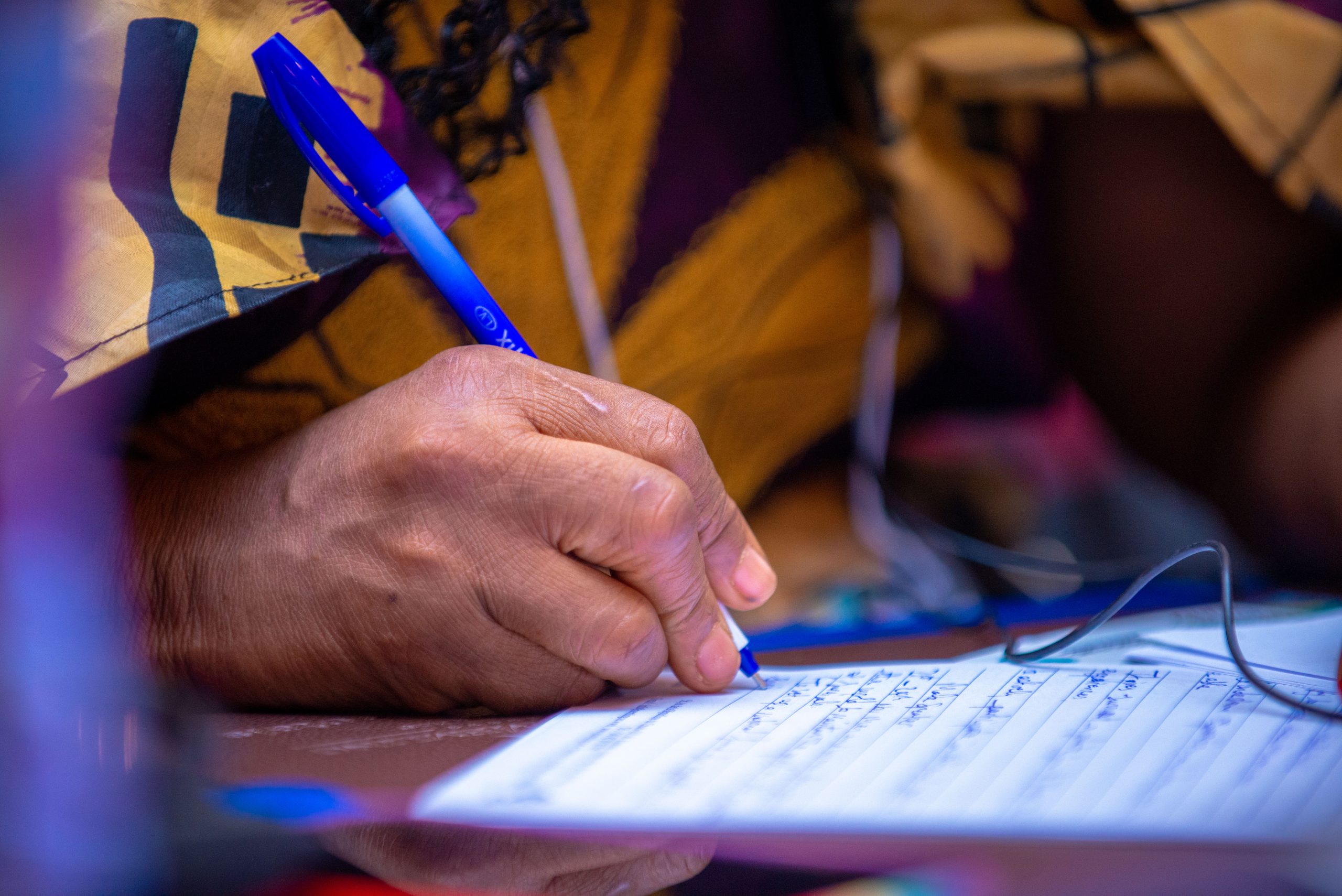
The starting point for any reparations programme is a database. Compiling a list of identifiable survivors is however a huge challenge, particularly when it comes to gathering information about conflict-related sexual violence, which requires trust from survivors and confidence that their safety will not be compromised.
The Global Survivors Fund (GSF) has faced this question of how to identify and register survivors in every context in which we have worked, even in countries where no register exists. It is a fundamental step in enabling survivors to access reparations or reparative measures. Identifying survivors and building sufficient trust for them to share personal details with our partners require a deep understanding of their concerns, and unique strategies to protect their confidentiality and ensure their security.
These challenges can be even more significant when such reparations programmes are ambitious and seek to cover a national population of survivors of conflict-related sexual violence, rather than the typically smaller-scale projects run by our partners.
What is a victim’s registry and why is it important?
A registry is a repository that systematically, confidentially, and securely records information about victims, including their identities, and other information to facilitate the verification of individuals as victims of specific violations, including conflict-related sexual violence. This is done with the aim of eventually enabling their access to appropriate forms of reparation.
Why is it needed? Efforts at documentation are mainly geared towards capturing evidence of violations for the purpose of criminal accountability. While much of the information comes from victims and survivors, the focus is often on identifying the perpetrators and preserving evidence of these crimes. A victims’ registry complements this. Its focus is the documentation, acknowledgement, and preservation of the experiences of survivors and the harms they suffered.
Victims’ registries contribute to the realisation of the rights to justice, truth, memory and guarantees of non-repetition. They facilitate the shift from a humanitarian response to a rights-based reparations programme; often, conflict-related sexual violence is subsumed into humanitarian responses to broader gender-based violence issues, which fail to take into account survivors’ unique rights and needs, including justice and other forms of reparation.
A registry constitutes one of the key foundations upon which national and international reparation programmes and policy responses are built, while also preserving collective memory by ensuring that violations are included in the historical record.
In many contexts, the failure to establish a comprehensive registry has led to a loss of historical memory regarding the experiences of victims and survivors and a continued uncertainty regarding who are eligible for state reparations. Establishing a registry many years after the violations creates significant challenges in terms of engaging survivors, collecting verifiable information and thus being able to fulfil their rights.
GSF’s experience with registries
In places such as Ukraine, Timor-Leste and Nepal, GSF’s experience shows that early survivor registration provides a key source of knowledge for reparation efforts, and is a critical foundation for advocacy. In Ukraine, our team and partners registered survivors of conflict-related sexual violence under government-led urgent interim reparation mechanism, which provided survivors with financial compensation and referrals for medical care. This process will continue under the implementation of the Bardina Law, which established a domestic reparation programme for survivors of conflict-related sexual violence, strengthening the foundations for a future national reparations programme for all victims.
In Timor-Leste, GSF and our partners, AJAR and ACBIT worked with survivors who had been identified in previous projects and by the country’s truth commission. They were however able to identify many more survivors who had initially not come forward. Through a more survivor-centred process of engagement, the team managed to significantly expand inclusion of survivors in the interim reparative measures project. Subsequent advocacy efforts have also ensured that a new draft reparation law can include survivors directly registered by survivor organisations.
GSF re-imagining victims’ registries: survivor-led, inclusive and reparative
Through partnerships with survivors and civil society partners, we have demonstrated that victims’ registries can be led from the ground. State and international partnerships are key, but they are not the starting point.
This experience has also shown the big difference made by survivor-centred registries. A registration system that respects the needs and rights of survivors and puts their priorities first fosters trust and ensures a broader inclusion of conflict-related sexual violence survivors.
Registration systems become reparative if done in a survivor-centred and trauma-informed manner that acknowledges suffering and conveys recognition. A registry is not just a tool for reparation – it can also serve as a form of reparation too.
Registration needs to be treated as a first step of a holistic reparation process. It should be complemented by other forms of reparation and ideally accompanied by urgent interim measures that address survivors’ most immediate needs and harms. Prioritising this provides a solid foundation for a survivor-centred response that can then support longer-term engagement to ensure full satisfaction of survivor’s rights to reparation.
