Yanet Peña’s life completely changed in 1994, when she was subjected to sexual violence in her hometown of La Granja in Colombia’s Santander region. From then on, she says, she was never the same: “Everything changed: my body, my soul, my sense of hope.”
What happened pushed her to leave her hometown in search of a better life. She and her family moved to a rural area in Tolima, another beautiful region. But violence followed, prompting Yanet to send the girls to their father in Bogotá. She later followed her children to the capital; they missed her deeply, and she missed them too.
Yanet is one of 110 women participating in Renace, a pilot in emotional rehabilitation for survivors of sexual violence committed during the Colombian armed conflict. Established by GSF and Colombia’s Victim’s Unit in 2025, Renace, or ‘rebirth’ in Spanish, aims to provide comprehensive emotional rehabilitation for survivors and gently guide them through the inner turmoil many are still experiencing. GSF followed Yanet’s journey through the initiative.
Her mood brightens as soon as she arrives at the Victim’s Unit headquarters, where she has gone to attend the six Renace sessions. All are run by psychologists or social workers, one of whom greets Yanet with a smile and places essential oils on her wrists.
‘Feeling to heal’
Renace sessions included themes such as ’embracing my being: building self-esteem’, ‘feeling to heal’ and the final session, ‘rewriting my future.’ The women learn how to deal with their emotions and how to mourn the past and reframe their experiences as more than just victimising events. Women’s circles, an ancestral healing ritual common throughout the Americas, are a central feature, alongside music therapy and meditation. Colombian culture is infused into every part of the sessions, with respect given to the country’s diversity.
“The strategy helps to manage or reduce the harm suffered by victims, to transition from victim to survivor”, says Diana Bravo, GSF’s Project Coordinator for Colombia. In addition to Bogotá, pilot sessions also ran in Apartadó, Cali, Florida Valle, Tumaco, and La Dorada. The locations were chosen based on the numbers of survivors present and areas where the conflict was particularly intense.
“They begin developing confidence in themselves and trust towards the other women. They recognise the many ways pain has unfolded in their hearts, their bodies and souls, and this first step leads them to accepting the need to heal, and that they don’t need to do that alone.”
Yanet Peña, a survivor of sexual violence in the context of the armed conflict in Colombia, is one of the participants of Renace, an emotional rehabilitation strategy, piloted in Bogotá and five other municipalities in Colombia during the second semester of 2025.
This abominable event changed Yanet’s life in 1994, and she was never the same person again. Everything changed: her body, her soul and her sense of hope.
She never thought of suing the guerrilla responsible for the victimising event, out of fear and ignorance. This is something that happened to many victims at the time.
The horrific event changed Yanet’s life in 1994, and she was never the same person again. Everything was different: her body, her soul and her sense of hope.
But despite choosing a rural area that seemed peaceful and healthy for her kids, violence returned; Yanet’s daughters, now teenagers, began to be persecuted by the army and local guerrillas. So she sent them to their father’s home in Bogota.
Yet her daughters’ first years in the capital city, with their father wasn’t positive, “it was terrible, he didn’t know how to deal with them,” Yanet recalls. So she sold everything and came to Bogota. This time with a new family member, her faithful companion.
Yanet remembers her childhood with some sadness. Those were happier times, when she was raised by her grandparents of whom she shows us a lovely photo and sighs. Evoking a happier past moved her emotions.
While she gets ready to leave home heading to the Victims Unit to participate in Renace, Yanet spoke about her leadership as a survivor.
She obtained her bachelor’s degree and decided to become a victim’s leader. This means that she helps other victims to overcome the atrocities they’ve lived.
Yanet remembers her childhood with some sadness. Those were happier times, when she was raised by her grandparents of whom she shows us a lovely photo and sighs. Evoking a happier past moved her emotions.
Yanet is motivated to attend Renace sessions, “even though I’ll never be the same person again, these kinds of initiatives are very helpful; one always needs help to recover.”
Yanet remembers her childhood with some sadness. Those were happier times, when she was raised by her grandparents of whom she shows us a lovely photo and sighs. Evoking a happier past moved her emotions.
The social worker begins with aromatherapy. Essential oils from plants are used to calm and harmonise the participants’ mood.
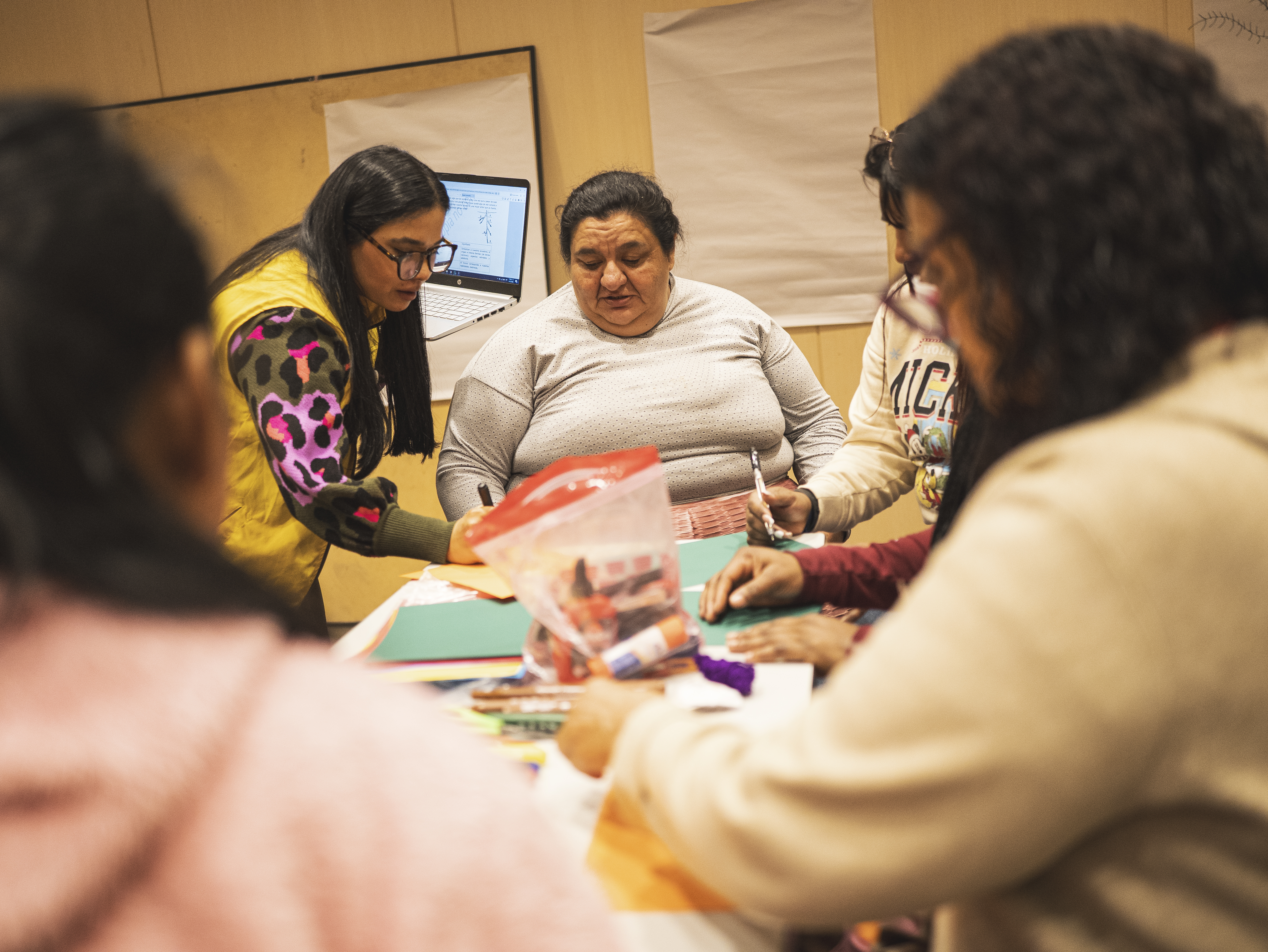
Crafts with a therapeutic purpose continue, and the attendees create drawings and posters with meaningful messages that aid their healing. Crafts also help them symbolise the damage and the consequences it has left in their lives.
Yanet does everything with enthusiasm. She uses her experience and shares her own learnings with her peers, and they do too. Sharing one’s own experiences helps with emotional recovery.
Self-esteem is a life skill that is essential to develop when one has suffered a traumatic event, which is why it is one of the cornerstones of Renace.
Yanet is a kind soul. Despite all the complexities of her own life, she manages to maintain her tenderness, kindness and human qualities. This does not weaken her fighting spirit and strength to demand her rights as a woman and as a victim.
Like many other victims of sexual violence, Yanet has gone through all the stages of grief for her past life. And she knows that initiatives like this are a start, a change, a new opportunity.
The transition of participants from victim to survivor is also achieved by identifying their own stories of resistance and resilience. And what better example than Yanet, who has transformed herself and used what she has learned to help other victims.
For the closing session, a symbolic act is performed. In Yanet’s group, they write positive notes about their future – enacting a ritual full of hope. It promotes the reconstruction of goals and celebrates the collective memory of pain and healing, as well as the recognition of one’s own journey of rebirth.
Several months were needed to develop the unique strategy. With the guidance of a group of psychologists and their fellow survivors, participants take their first steps into recovery where trust and respect are essential. The social workers teach emotional regulation strategies “to navigate moments of high emotion.” In the second session, which lasts over three hours, survivors learn to recognise their emotions as natural responses to the harm they have endured, and validate their experiences. They ended with exercises to symbolise and relieve their pain.
“Renace is a very good initiative, although it doesn’t completely heal or repair, because after a rape one will never be the same person, it is a first step in recovery and it helps”, Yanet told the team.
All kinds of emotions are explored through artistic activities and guided conversations, to help them reframe the past and view the present in a different light. During these sessions, an atmosphere of compassion, solidarity, and empowerment is felt throughout the room. Friendship and the desire to move forward blossom. This is when change begins and healing paves the way to start seeing a future with hope. They come to understand they have the right to be recognised, heard and supported.
In later sessions, Yanet and the other women dive deeper into what it means to be a survivor, and a woman with rights and dreams. After a relaxation exercise, they settle into a discussion on the theme of ‘things the conflict can’t take away from me.’ At the next meeting, group art sessions accompany activities to ‘recognise’ oneself and enjoy aromatherapy.
Maria Alejandra Cortazar, who facilitated Renace sessions in Cali, said: “what most surprised participants, was that the experience helped them realise all the abilities and strength they themselves had generated to move forward […] because it was something they were not aware of, but thanks to Renace, they realised their own strength.”
It surprised us to see how Yanet has overcome everything that has happened to her and her family. It’s fulfilling to watch her shine with her peers, as they hug each other goodbye, with smiles in their faces, knowing it’s more a “see you later, new friend” than a farewell.
Though its results are yet to be formally analysed, participants report feeling better and “looking at their future with hope”. Dropout rates were also low, signalling a positive reaction to the sessions.
GSF believes that more than 44,000 survivors of conflict-related sexual violence registered in Colombia could benefit from this kind of approach through government ownership of the model to roll out nationally. In 2026, the country team will continue working with survivors and the Victim’s Unit to move forward with this.
For the time being, survivors of sexual violence in Colombia continue to wait for government policies to deliver full reparation.