
May 25th was Colombia’s National Day for Victims of Conflict-Related Sexual Violence, a date born from the courage of one woman, Jineth Bedoya Lima, a journalist and survivor, who requested this commemoration as part of her own reparation process. Established in 2014, this national day remains both an achievement of survivors and a reminder of how much work remains to ensure that victims’ rights are fully realised.
This year, GSF, our partners, and survivors co-created a commemorative space to host a panel discussion and temporary exhibition on the theme ‘To repair is to dignify.’ Survivors from various communities, their leaders and grassroots organisations came together for this event.


Survivors take part at the commemorative ceremony for the National Day for Victims of Conflict-Related Sexual Violence in Colombia. Bogotá, May 2026. Manuela Pombo Holguin/GSF

Survivors took the lead and designed the space, what they wanted to discuss, and who they wished to invite. They chose to display hand-painted textile pieces that reflect their experiences and have become part of their healing journeys and advocacy efforts.
A healer from the Afro-Colombian organisation La Comadre opened the gathering with a healing ritual rooted in tradition. She arranged a mandala in the centre of the room with flowers, sweets, plants, water, and fire, each element carrying a healing, cleansing or welcoming element. In a room of nearly 80 participants, she invited everyone to hold hands and, one by one, share a single word that captured what the gathering meant to them.
“Peace. Sorority. Truth. Justice. Strength. Reparations. Love.”
The words came slowly at first, then steadily, and everybody listened. It felt less like an event and more like an intimate healing circle and a safe space. It was the kind of moment that set the tone for the day, creating a space where every woman felt held.
Before opening the floor to a survivor panel, Diana Bravo, GSF’s Colombia country lead, asked the room to hold each other once more – this time, in a minute of silence for the son of one survivor who was murdered just weeks before. It was a stark reminder that for many of these women, the violence has never fully stopped. Yet, despite her recent loss, the bereaved mother chose to continue playing a prominent role in the gathering, illustrating how leadership can become part of survivors’ journeys of healing and advocacy.
The floor then opened to seven survivor leaders, moderated by Andrea del Pilar García – an official from the Ombudsman’s Office of Colombia – who has played a key role in supporting survivors. The questions guiding the conversation had been asked by fellow survivors for years: What has your organisation put in place to support other victims? What do you wish institutions and society truly understood about survivor-led movements? What does reparation that truly dignifies survivors actually look like?
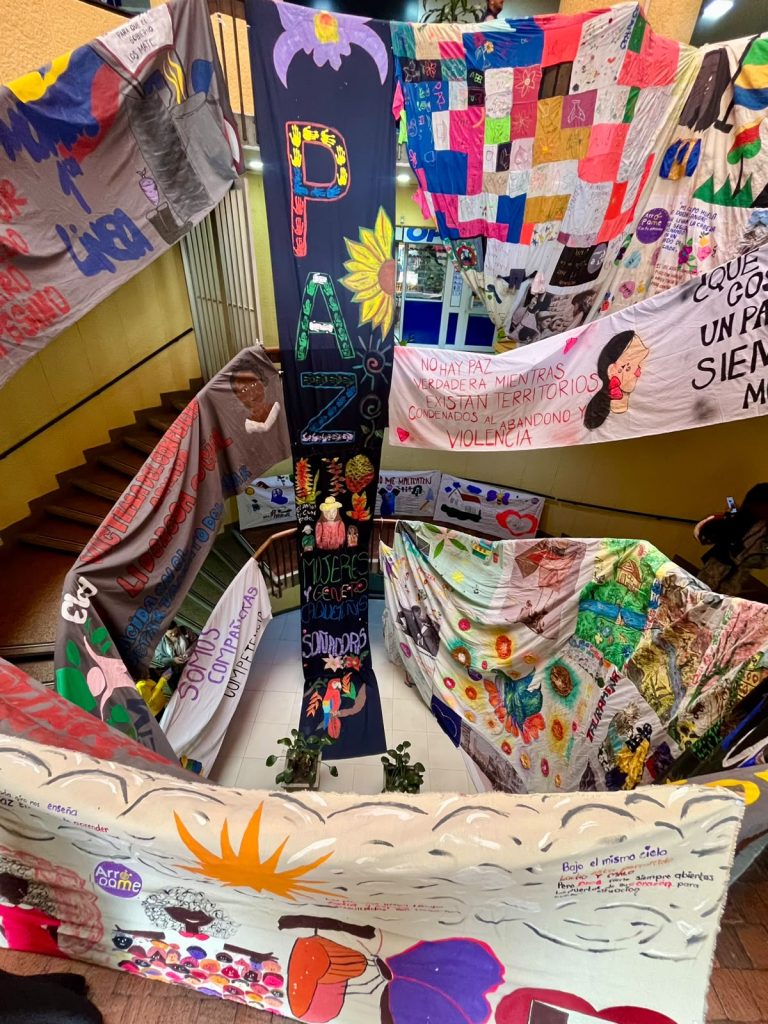
Hand-painted textiles by survivors adorn the building where survivors gathered for the commemorative ceremony for the National Day for Victims of Conflict-Related Sexual Violence in Colombia. Bogotá, May 2026. Manuela Pombo Holguin/GSF
Each woman answered with her own experience as a survivor, as an Afro-descendant, as an Indigenous woman, as a mother, as someone who has spent years turning her own pain into advocacy for others. Their answers varied but generally carried the same message: reparations must be built with survivors, not delivered to them. The State has taken steps in this direction, but more action is needed. Participation is a right that belongs to victims.
The event was attended by international agencies, embassies, and technical-level state entities. Survivors highlighted how, in many cases, representatives at the decision-making level attend events but do not stay until the end, when survivors speak. And so the panel closed with a call to action: for officials to show up, listen, and deliver. And so the panel closed with a call to action: for officials to show up, listen, and deliver.
It is from survivors’ sense of collective strength that ALZA1 (to rise) was born. The event served as the official launch of the movement of women from these different organisations, backgrounds, and territories, who raised their voices together on May 25 to demand that the Colombian State fulfil its obligations: effective reparation and guarantees of non-repetition, without further delay.
Attendees stepped outside the auditorium to find the Ombudman’s building draped in textiles crafted by survivors from Arrópame con tu Esperanza and MUVICEM – each piece showcasing a different story, representing a different region, a different hand that had turned pain into something visible and enduring. The day reminded us that survivors are not alone.
- ALZA is composed of the following organisations: Arrópame con tu Esperanza, Asociación de Mujeres Wiwa, Corporación Integral Social Alianza, Corporación Mujer Sigue Mis Pasos, Fundación Reconstruyendo Vida, La Comadre, and Mujeres Víctimas Emprendedoras (MUVICEM). ↩︎