
GSF’s Diana Bravo, Country Coordinator for Colombia, was interviewed for this article by El Espectador. You can find the original publication in Spanish here.
Colombia’s Special Jurisdiction for Peace (JEP) has issued its first territorial order devoted exclusively to sexual violence and other forms of gender-based violence committed during the armed conflict. Issued under Macro Case 05, which covers the regions of northern Cauca and southern Valle del Cauca, the order marks a significant step forward. The challenge now is to ensure that those appearing before the JEP acknowledge their responsibility and that the State advances reparation for survivors.
For years, sexual violence committed during the armed conflict remained hidden behind survivors’ silence, fear of reporting, and institutional barriers to investigating and prosecuting those responsible. The JEP’s efforts to identify these crimes, establish patterns, and attribute responsibility to former FARC commanders therefore represent a major step forward. This progress is reflected in Order 014 of 2026 in Case 05, concerning northern Cauca and southern Valle del Cauca.
The order is the result of years of demands by survivors, who have had to navigate distrust and barriers to accessing justice. Their participation took shape as they found spaces to come together, organise, and demand accountability. They did not come forward merely to recount what had happened to them, but to insist that their experiences serve as the foundation for investigations and that hold those responsible accountable for the harm they caused. “This process before the JEP shows that justice is slow, but it arrives. Today we feel hopeful,” said a survivor participating in the case.
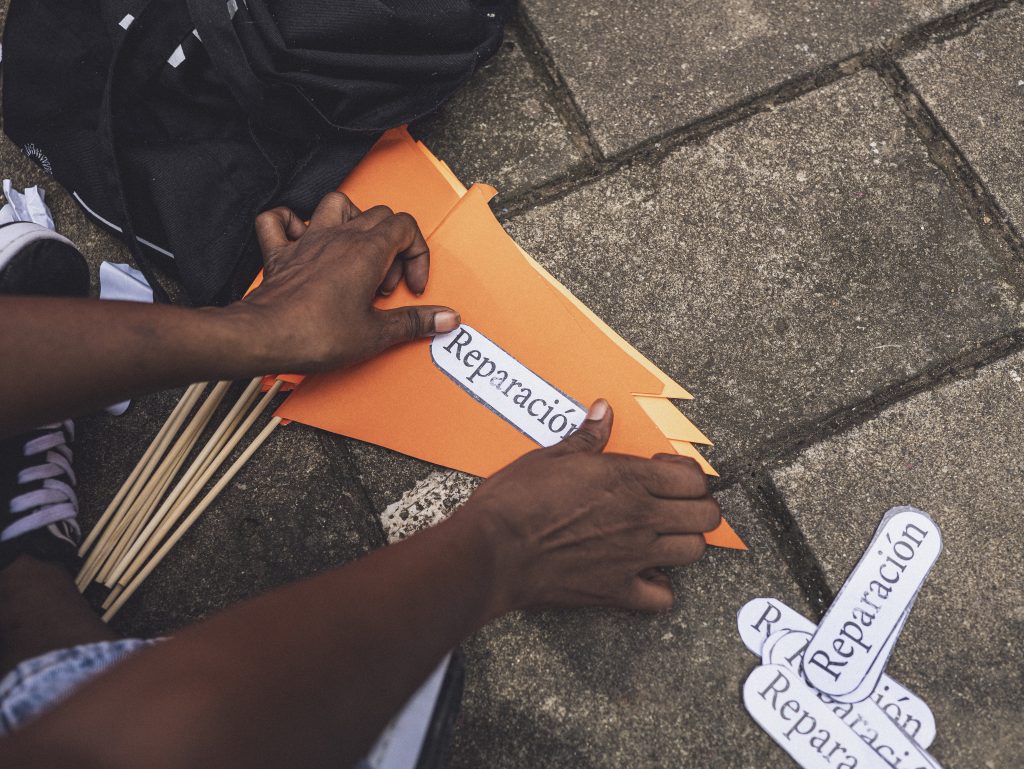

Women survivors of conflict-related sexual violence hold a demonstration in Colombia, demanding their right to reparation be fulfilled.

Raúl Sánchez, JEP magistrate and rapporteur for the case, explained why a dedicated investigation and a separate order addressing these crimes were necessary: “The order is the result of a different investigative approach that responds to the need to overcome the historical invisibility of these crimes through an exhaustive investigation that made it possible to understand a phenomenon marked by silence, stigma, and evidentiary difficulties.”
“To that end, it was necessary to create a special participation process that generated conditions of trust and safety for victims to address what happened to them. This also made it possible to understand the harms from a territorial and ethnic perspective, taking into account the particularities of Indigenous and Afro-descendant victims and of the LGBTQIA+ community. This approach also prevents these crimes from being subordinated to, or diluted within, the investigation of other serious crimes committed during the armed conflict, and it allows responsibility to be established beyond those who directly committed the violations.”
Order 014 attributes responsibility to the former FARC for crimes against humanity, including rape, other forms of sexual violence of comparable gravity, and gender-based persecution. These crimes were committed against the civilian population between 1999 and 2016 as a means of exercising territorial and social control in this part of the country.
The order also attributes responsibility for war crimes, including rape, torture through forced abortions, and outrages upon personal dignity through practices such as forced contraception. These crimes were committed against women who belonged to the former guerrilla group, some of whom had been forcibly recruited.
Putting survivors at the centre: co-creating reparation measures
The special process for survivor participation has been supported by the Global Survivors Fund (GSF), an international organisation that works to improve the right to reparation of survivors of sexual violence in countries affected by armed conflict.
Since 2023, GSF has worked alongside survivors to develop a co-creation process aimed at transforming their role in transitional justice. Survivors are not merely participants in the proceedings: they raise questions, propose solutions, and help shape the responses to the harms they have suffered. The process also recognises the essential role of the organisations that have represented and supported survivors for years in their pursuit of justice.
This meaningful participation is reflected in the order’s recognition that sexual violence during the armed conflict caused both individual and collective harm. Survivors experienced anguish, fear, depression, and isolation, as well as damage to their physical and reproductive health. Many also endured stigma and victim-blaming, lost educational and employment opportunities, faced economic hardship, and experienced the breakdown of family and intimate relationships. For some, the consequences extended to threats, further displacement, and revictimisation by the very institutions they approached for assistance.
The harm went beyond individual experiences. Sexual violence was used as a means of territorial and social domination, undermining community organisation and opportunities for social and political participation. It also disrupted cultural practices, spirituality, and relationships with ancestral territories among Indigenous peoples and Afro-Colombian communities.
One survivor recalled: “Because of the fear of being attacked, women have stopped going to the river. Women used to go to fish with timbo, to wash clothes, and that is being lost. The new generations don’t know what that is.”
The order also recognizes the violence and discrimination experienced by LGBTQIA+ people, which even undermined their ability to exercise leadership within their communities.
The challenge of the right to reparation
Diana Bravo Rubio, GSF’s representative in Colombia, emphasises the importance of placing survivors at the centre of restorative justice:
“For years, victims were not heard. Today, restorative justice offers an opportunity for co-creation because it puts victims at the centre, promotes their participation, and seeks to recognise and repair different dimensions of harm, unlike a conception of justice centred primarily on responsibility and criminal punishment of perpetrators. In cases of conflict-related sexual violence, dialogical spaces are especially important: survivors need what they lived through to be acknowledged, the consequences that violence has had on their lives to be understood, and reparation to be provided. This process has been guided by the conviction that advancing justice and reparation for victims is the path to peace.”
Ensuring that the State provides reparation for survivors of sexual violence within armed groups, including those subjected to forced recruitment, is another urgent challenge. To address this, GSF filed a constitutional challenge against provisions of Colombia’s Victims’ Law that exclude these survivors from the Single Registry of Victims, thereby restricting their access to reparation measures. The action also challenges other legal provisions that place bureaucratic burdens on survivors because of inadequate coordination among the institutions responsible for safeguarding their rights. The Constitutional Court must now rule on these barriers to justice and reparation.
Next steps
As proceedings before the JEP continue, a fundamental question remains: what role will survivors play in the next stage of the process?
The order opens a period during which the perpetrators may acknowledge or deny the responsibility attributed to them. If they provide adequate acknowledgment and meet the conditions established by the transitional justice system, restorative sanctions may be imposed.
Through the co-creation process, survivors made a concrete proposals, including the establishment of survivor support centres as part of restorative measures, acknowledgment of the truth by perpetrators, and access to individual reparation measures provided by the State.
According to GSF, making these proposals a reality will require strong institutional capacity. Implementing restorative sanctions demands adequate resources, coordination among public institutions, the capacity to deliver agreed-upon measures, security guarantees, and effective monitoring mechanisms.
After years of investigation and survivor participation, it would be unacceptable for projects agreed upon with survivors to remain on paper, never to be implemented. Reparation cannot depend solely on the willingness of those appearing before the JEP or on the efforts of the organisations supporting survivors. The State must ensure that the rights recognised are effectively upheld and translated into concrete measures.
For a survivor of sexual and reproductive violence, having the justice system recognise what happened as a serious crime is a historic moment. But recognition alone is not enough. Justice must also lead to accountability, effective restorative measures, and reparation that addresses the harm suffered and helps survivors rebuild their lives.