
By Esther Dingemans
I have just returned from Chad, where I visited refugee camps for those who fled the conflict in Sudan, including many women and girls subjected to conflict-related sexual violence. I came back quite shaken by what we witnessed, but also more convinced than ever that there is an opportunity – an urgent one – to make a difference in what has become a profoundly neglected context.
Over the course of the visit, our team held eight focus group discussions with approximately 20 social workers, 80 participants in our project, survivors of conflict-related sexual violence. While jointly designing the next phase of our work, we learned about crimes that are impossible to comprehend in their scale and brutality. Many survivors experienced sexual violence in Sudan itself but also continue to face further atrocities after fleeing. To get by, they are forced to leave the camps to search for firewood, water, or day labour for little over a dollar a day, where they are vulnerable to further attacks. Women and girls are exploited, and children are being forced into marriage at even earlier ages than before.
One adolescent girl said to us: “My father passed away. My mother went to sell tea at a hospital far away from the camp. She was abducted and found a day later. She had been raped and was killed. She was the only one taking care of us. Now we are all alone.”
What struck me most painfully is that this is not simply a humanitarian crisis, or a rise of ‘gender-based violence.’ We need to look at this for what it really is: gross violations of human rights, that come with a right to reparation for survivors. It has been widely documented by the UN and other actors, that sexual violence is still being used as a weapon of war in Sudan, and there are all indications that sexual violence continues across all borders of Sudan. Women and girls are trapped in cycles of violence, exploitation, stigma, and extreme insecurity long after crossing the border to apparent safety. This needs more attention, and critically, action on reparations.
The scale of unmet need is staggering. Psychological support is almost entirely absent in what I can only describe as a mental health emergency. In some camps, there is not a single women’s centre or safe space for survivors. Where they do exist, some have been compromised and faced attacks from perpetrators. There are very few livelihood opportunities. Girls who were once students – some in university before the war – have now missed three years of education. Many are first-time mothers and are trying to care for their babies born of rape while facing rejection from their families and communities.
And yet, despite this, it is women who are showing up for each other. They are the first responders – organising informal psychosocial support, tea circles, community solidarity networks, and protection for one another in the near-total absence of international support. Many of these women are survivors themselves. While systems fail them, they continue to hold their communities together with extraordinary courage.
We lived through a terrible experience. Our minds are terribly affected. As a first thing we need is to come together. For social activities, for tea sessions. To find solutions together and to support each other.
— A young survivor of sexual violence in Chad
Moving beyond an emergency response
Again and again, survivors described safe spaces and peer support as lifelines. Alongside community-based organisations, Global Survivors Fund and its partners have begun establishing safe spaces in some locations that are already becoming much-needed places of healing, solidarity, and protection for women and girls. The contrast between camps where these structures exist and those where they don’t is immense.
Over the past year, Global Survivors Fund and our partners have worked hard to put the foundations in place for a much deeper and more sustained response. But it is clear to us now that we are only scratching the surface of what is needed.
This requires all actors to move beyond emergency response or minimal GBV programming and begin laying the foundation for reparation, even in the midst of the ongoing war and displacement crisis. Reparation is a state responsibility, but it is here that GSF’s proven concept of interim reparative measures can make an immediate difference. Survivors were clear that they want and need tailored support to start rebuilding their lives. As a case worker said, it is time to think outside the box. Survivors also want their experiences to be documented. There is a real need for a victims’ registry – for recognition and for what they endured to be officially recorded. This can later be used to provide reparation.
To start, we must ensure survivors can be protected from further violence. Meeting women and girls who have been raped not once, but twice or three, four times is not just horrifying, it is unacceptable.
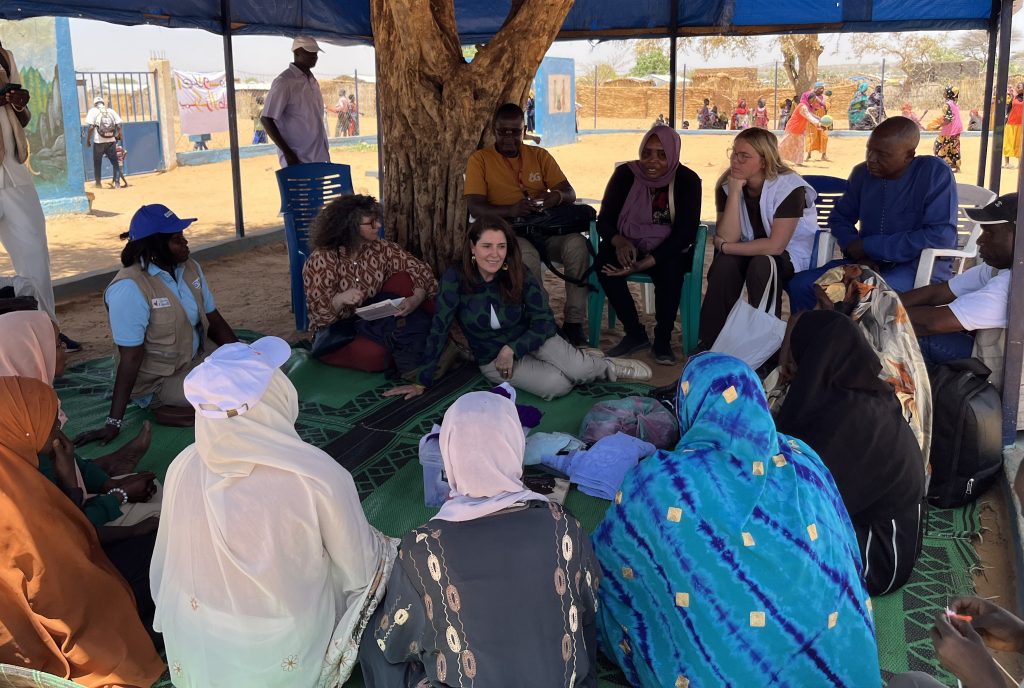

During a visit to Abutengué, Esther Dingemans, Executive Director of GSF, joins MSF and partners in meeting with parents at Abutengué School, Chad, May 2026. Ludovic Franchi.

It was only halfway through one focus group that I realised that almost every child in the room was caring for a new-born, some huddled beneath their clothes. These were babies born following sexual violence, born to girls still children themselves. There is a particular urgency around children affected by conflict-related sexual violence – including child survivors, children born of rape, children who have witnessed sexual violence, and those whose caregivers have suffered this violence. These children are among the most invisible groups in the humanitarian response, facing immense barriers to education, social inclusion, and recovery.
Education came up repeatedly in our discussions as a source of hope and survival. Girls spoke about desperately wanting to return to school, but feeling unable to do so without psychosocial support, childcare, livelihood support, and trauma-informed approaches. This aligns with our broader work on education as a form of reparation. With survivors still at so much risk, investing in education is also crucial to putting a stop to further cycles of violence.
Many crises around the world are competing for funding and attention right now. But I have such a profound sense that women and girls from Sudan are being left almost entirely alone with the consequences of unimaginable violence – and that, with the right support, we have a genuine opportunity to change that trajectory.