
The Indonesian occupation of Timor-Leste ended almost three decades ago, but for many people, the memories of atrocities committed then are still very much alive – and survivors fear their experiences will be forgotten with the passage of time.
“If I don’t tell my story, who will?” is a question we heard often in meetings with survivors of conflict-related sexual violence across the country during our visit in May. As many survivors advance into old age, they decided to take action and ensure their history can be passed down to the next generation.
Ten memory books were created out of this desire to remember, record and commemorate the experiences of Timorese survivors and their children born of sexual violence. In special consultations with survivors, they chose to create the books, each covering a different municipality, as a form of collective reparative measure. With this choice came the opportunity for some to share their story publicly for the very first time.
“I want people to hear my story. It’s important to have it in my hands and show it to my children,” survivor Agrifina Soares told us outside her home in the village of Cassa. She awaits the local launch of the Ainaro edition, which features page-length testimonies from each participant.
Nizio Carvalho, a coordinator with the Asosiausun Chega Ba Ita (ACbit), led the memory book process. ACbit and AJAR staff crossed the country as part of the initiative, working with dinamisadoras to meet survivors and record their testimonies.
“Timorese are known for telling stories,”he said at the Dili launch. “Survivors don’t want their stories to die with them. They want them to be a lesson for others and to counter the dominant narratives of war. One said ‘this is a book to remember me by.”
At a launch event for the Dili memory book, women gather dressed in tais, a traditional Timorese textile. Prayers and a minute of silence are held for survivors who have passed away, broken occasionally by the sound of quiet tears.
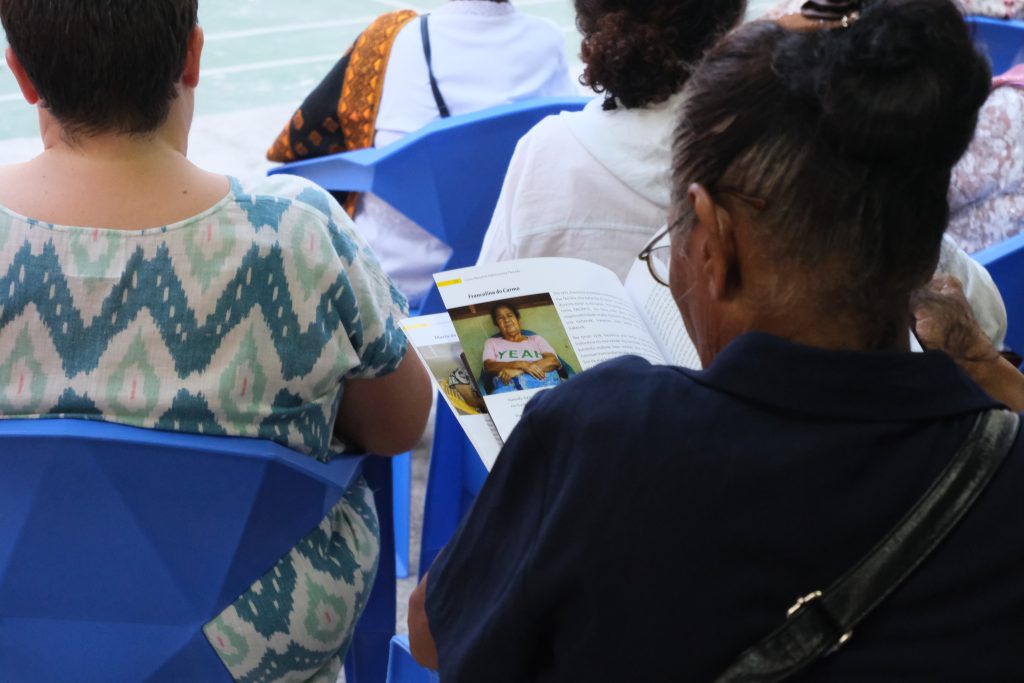

A woman reads the Dili memory book during the launch event. Dili, May 2026. Holly Johnston/GSF

Included in the Dili memory book is the story of Maria Isabel Jesus da Silva, a project Steering Commitee member and the president of the Pirilampu survivor network. The book, Lalatak no Roman Pirilampu (the light and shadows of fireflies), references a symbol chosen by survivors to represent the light that brightens when they come together.
In the foreword, she says she hopes the memory book “can be an inspiration to leaders and the state” to provide repair to survivors, adding “we want the government to recognise our contributions [to independence].”
Idalina Dias Manggo is a daughter of a survivor, now deceased, and was born of sexual violence. At the launch, she recites a poem that also features in the memory book. Dressed in a black and orange tais, she pauses to catch her breath as she becomes emotional.
“The world looked at her with judgemental eyes, words sharper than a bayonet.” she said, continuing: “every breath of her child is a small victory against the unfriendly world.”
‘I’m a survivor too’
In the village of Mauchiga, we are greeted by Filismeno Lopes outside the home he finished with the financial compensation he received from the project. He proudly shows off the television and ornate wooden cabinet he bought with the remainder, allowing him to watch the news “to give him something else to focus on.”
He joined the project after the team came to speak to his wife, now deceased, about the initiative: “It was then that I said I’m a survivor too.”
“It’s the only time someone has written down my story,” he said of the memory book, adding he is looking forward to its release.
Filismino was forcibly displaced to Atauro island, off the coast of Dili, during the occupation. With AJAR and his fellow survivors, he plans on returning for the first time since 1985 to map where they were held and record their stories. He also featured in AJAR’s Bukae documentary following survivors’ fight to justice, and is eager to share his story.
“It’s been decades since I’ve spoken about it, and I am excited someone has taken an interest.”
In GSF visits across Timor-Leste, survivors and their children said that they plan on keeping their copies of the memory books for their descendants.
“Our stories were kept secret for a long time, so I feel good that they will finally be published,” Lourdes Araujo Sarmento, who was born of sexual violence, told us from her home in Ainaro.
“We who are brave, are brave, but there are still some people who feel ashamed. Only us women know what it was like to go through that,” added survivor Mariana Cardoso, whose testimony is included in the Covalima memory book.
“Even if our candle burns out, we remain: our stories still exist. I am really glad they will be there.”